Michigan SNAP Calculator
Calculate your estimated monthly benefit, then see how MI Bridges runs the paperwork, what the Bridge Card buys, and how Michigan counts overtime and seasonal wages. Facts up front: MDHHS administers the program, deposits follow the FY2027 chart from $306 for one person to $1,841 for eight, and offices cover all 83 counties.
Michigan runs its food stamp program under the plain name Food Assistance Program, or FAP. The Michigan Department of Health and Human Services, better known as MDHHS, handles every case.
Its offices cover all 83 counties. Around 1.49 million Michigan residents received benefits in an average month last fiscal year. Payments arrive on a plastic card most people here call the Bridge Card.
Michigan gives most households more room than the federal floor. The gross income test sits at 200 percent of poverty, not the 130 percent ceiling many states enforce.
Since March 2024, the state has skipped the asset test for nearly every group. Your savings account will not by itself sink a Michigan application. Deposits land between the 3rd and the 21st of each month.
Several Michigan extras are worth knowing before you apply. Double Up Food Bucks matches produce dollars at more than 240 stores and markets.
A Restaurant Meal Program serves older, disabled, and homeless residents. SSI recipients qualify through a simplified route called MiCAP.
Work rules changed sharply in 2026. A federal waiver shielded most Michigan counties from time-limit rules until February 28.
MDHHS now applies the new federal requirements statewide. A short list of counties and cities still holds waivers.
Every figure was checked against the MDHHS food assistance hub and USDA sources in September 2026. The numbers cover the fiscal year through September 30, 2027. Our Michigan SNAP calculator uses the same values.
On this page
- What FAP Means in Michigan
- How the Michigan SNAP Calculator Works
- Michigan's 200 Percent Income Door
- Income Limits Through September 2026
- Gross Test, Net Test, and Michigan's Twist
- Asset Rules: No Limit for Most Groups
- Deductions That Lower Countable Income
- Maximum Benefits for FY2027
- Inside the MDHHS Issuance Table
- Four Michigan Budgets Worked Out
- Deposit Dates: the 3rd Through the 21st
- MI Bridges Puts Your Case Online
- Applying for Food Assistance Step by Step
- MiCAP: SNAP Without the Paperwork for SSI
- Inside the Bridge Card
- The 274-Day Rule for Unused Benefits
- Shopping Online from Michigan
- Double Up Food Bucks Doubles Your Produce
- Restaurant Meals for Older and Disabled Residents
- Summer EBT for Michigan Kids
- Work Rules After March 2026
- Reporting Changes and Renewal Cycles
- Stolen Cards and Scam Alerts
- Non-Citizen Eligibility After April 2026
- Students, Military Families, and Migrant Workers
- If MDHHS Says No: Your Appeal Rights
- How Michigan Counts Overtime and Seasonal Wages
- County Offices and Community Navigators
- More Help on the Same Application
- Frequently Asked Questions
- Compare Michigan with Its Neighbors
What FAP Means in Michigan
Ask for food stamps in Michigan and nobody will blink. The paperwork says Food Assistance Program, or FAP.

The federal government calls it SNAP and funds every dollar of it. MDHHS administers the rules, runs the interviews, and loads the cards. All three names lead to the same application.
The scale here is larger than most people guess. About 1.49 million Michigan residents received benefits each month in fiscal 2025.
The average benefit ran near $175 per person. That average covers very different situations. A single retiree and a Grand Rapids family of four can both qualify under the same chart.
Households are defined by buying and eating together. Everyone who shares meals counts as one group, even when rent is split.
Roommates who shop and cook separately file separate cases. Married spouses generally count together. Children under 22 living with a parent join the parent's group.
How the Michigan SNAP Calculator Works
The calculator at the top of this page mirrors the math MDHHS uses. You enter your household size, each earner's pay, and the big expenses.
Rent, utilities, child care, and medical costs all matter. The tool applies the 200 percent gross door first. It then subtracts Michigan-allowed deductions and reads the result off the state's own benefit table.
An estimate takes under a minute and asks for nothing that identifies you. It cannot replace the official decision, because MDHHS verifies wages and identity with documents.
What it removes is guesswork. You see whether your income sits under the door before gathering a single pay stub. You also learn which deduction does the heavy lifting for your estimate.
Check the estimate against the sections below if you want every step traced. The income chart, deduction list, and issuance table all appear here in full.
The worked examples show the arithmetic for four real Michigan situations. One covers a Detroit family of three. Another follows a Lansing single with a modest pension.
Michigan's 200 Percent Income Door
Federal rules set the standard gross income test at 130 percent of poverty. Michigan uses a federal option called broad-based categorical eligibility to raise that door.
Most households here pass the first screen at 200 percent of the poverty line. That is one of the most generous doors in the Midwest. It is the biggest reason Michigan applications succeed where they would fail in stricter states.
Using 2025 poverty guidelines, the ceiling works out to roughly $2,660 a month for one person. A family of four can earn about $5,500 monthly and still pass.
Each extra member adds roughly $948 to the ceiling. The door moves every October with the federal cost-of-living adjustment. A raise that felt risky last year may still fit under the FY2027 line.
Passing the gross test only gets you to the benefit calculation, not a payment. Benefits still depend on net income after deductions.
Households above 200 percent keep one narrow path when a member is 60 or older or disabled. That path is covered under the asset section below. Our guide to BBCE states shows how Michigan compares nationally.
Income Limits Through September 2026
The table below lists the federal standards that drive every Michigan case this year. The year runs through September 30, 2027.
The gross column matters less here than in most states, because Michigan's own door sits at 200 percent. The net column still decides who gets a payment, and it applies to every household.
| Household size | Gross monthly limit (130% FPL) | Net monthly limit (100% FPL) |
|---|---|---|
| 1 member | $1,729 | $1,330 |
| 2 members | $2,345 | $1,804 |
| 3 members | $2,960 | $2,277 |
| 4 members | $3,575 | $2,750 |
| 5 members | $4,191 | $3,224 |
| 6 members | $4,806 | $3,697 |
| 7 members | $5,421 | $4,170 |
| 8 members | $6,037 | $4,644 |
| Each extra member | +$616 | +$474 |
The USDA publishes these limits in its annual cost-of-living adjustment on the FNS program rules page. MDHHS adopts them without changes.
Older adults and people with disabilities follow a two-part screen instead. Their gross income can exceed the standard door as long as net income stays under the 100 percent column.
Wages count when received, not when earned. A missed paycheck or a bonus shifts the month it lands in.
Self-employment counts after business expenses. The next section explains how the two tests interact and where Michigan's version diverges from the textbook.
Gross Test, Net Test, and Michigan's Twist
Every SNAP case runs through two filters. The gross test looks at money coming in before any deductions.
The net test starts from that figure and subtracts approved expenses. The result then compares with the 100 percent column of the chart above. A household must pass both filters to receive a payment.
Michigan's twist is the height of the first filter. Under broad-based categorical eligibility, most groups pass at 200 percent instead of 130 percent.
Households with a 60-plus or disabled member skip the gross screen entirely. They face only the net test. The net test still keeps the actual benefit tied to real need.
The net test is where deductions do their work. Rent, utilities, child care, and medical bills all reduce countable income.
Because deductions scale with real expenses, two families with identical pay can land at different benefits. A Lansing renter gains far more from the shelter deduction than a homeowner with a paid-off house.
Asset Rules: No Limit for Most Groups
Michigan removed the asset test for most food assistance groups effective March 1, 2024. A checking balance, a retirement fund, or a second vehicle does not disqualify an ordinary applicant today.
The car you drive to work and the home you live in were never counted anyway. What changed is that bank savings no longer count either. That matters enormously for families trying to climb out of a crisis.
There are exceptions, and the MDHHS eligibility guidance states them plainly. A group loses the asset exemption after an intentional program violation disqualification.
A fleeing felon disqualification triggers it too, as does an employment and training penalty on the head of household. Those groups face a $3,000 resource limit. The ceiling rises to $4,750 when a member is 60 or older or disabled.
Households above the 200 percent income door keep one more path worth understanding. When a member is older or disabled, the group can qualify under the federal net income test.
A $4,750 resource ceiling applies in that situation. Michigan Legal Help documents this route for applicants with high medical bills. Most applicants never need it, because the 200 percent door already covers them.
Deductions That Lower Countable Income
Deductions turn gross income into net income. They explain why two families with the same paycheck can receive different benefits.
MDHHS follows the federal deduction set, updated each October. The table below shows the FY2027 figures your case will use.
| Deduction | FY2027 value |
|---|---|
| Standard deduction, 1 to 3 members | $217 |
| Standard deduction, 4 members | $229 |
| Standard deduction, 5 members | $268 |
| Standard deduction, 6 or more | $308 |
| Earned income deduction | 20% of gross earnings |
| Shelter deduction cap | $769 |
| Homeless shelter deduction | $205.66 |
| Medical deduction, 60-plus or disabled | costs above $35 monthly |
| Dependent care | actual cost, no cap |
| Court-ordered child support paid | actual cost, no cap |
The shelter deduction covers rent or mortgage, taxes, insurance, and utility allowances. The cap sits at $769 for most groups.
Households with an older or disabled member are exempt from that cap. That exemption alone can swing a benefit by hundreds of dollars. Michigan also counts telephone expenses in its utility calculations, a detail many applicants miss.
Dependent care that makes a shift job possible counts in full, so keep those receipts. Our plain-language guide to SNAP deductions walks through each line with examples. Seniors balancing medical bills should read the seniors and disability guide next.
Maximum Benefits for FY2027
The maximum allotment is what a household with no countable net income receives. Most working families land below the maximum because earnings offset it at a 30 percent rate.
The maximums below match the federal chart for the 48 contiguous states. They apply in Michigan through September 30, 2027.
| Household size | Maximum monthly benefit |
|---|---|
| 1 member | $306 |
| 2 members | $562 |
| 3 members | $808 |
| 4 members | $1,023 |
| 5 members | $1,217 |
| 6 members | $1,463 |
| 7 members | $1,616 |
| 8 members | $1,841 |
| Each extra member | +$225 |
Households of one or two people never receive less than $25 a month once they qualify. Larger groups have no guaranteed minimum.
Their benefit can calculate to zero if net income climbs high enough. A zero calculation still counts as eligibility on paper. It can qualify the children in the group for free school meals.
Beware of older charts floating around the internet. A few still show the maximum for eight people from two fiscal years ago.
The current federal maximum is $1,841, and each additional member adds $225. When federal numbers change each October, the change lands in Michigan on the same day.
Inside the MDHHS Issuance Table
Michigan publishes its own benefit grid, the Food Assistance Issuance Table, in the MDHHS Reference Tables Manual. It converts net income directly into a dollar benefit for groups of one through eight.
The mechanics are simple enough to check by hand. Multiply net monthly income by 30 percent, round down to the nearest dollar, and subtract from the maximum allotment.
The official table runs 82 pages, so the extract below shows a few representative bands. Reading it is the fastest way to predict your own benefit. Find the band your net income falls in, then read across to your group size.
| Monthly net income | 1 person | 2 people | 3 people | 4 people |
|---|---|---|---|---|
| $0 | $306 | $562 | $808 | $1,023 |
| $57 to $60 | $288 | $544 | $790 | $1,005 |
| $97 to $100 | $276 | $532 | $778 | $993 |
| $147 to $150 | $261 | $517 | $763 | $978 |
| $247 to $250 | $231 | $487 | $733 | $948 |
| $497 to $500 | $156 | $412 | $658 | $873 |
| $1,251 to $1,253 | $25 | $186 | $432 | $647 |
Notice how the math plays out in the rows. Every extra $100 of net income trims roughly $30 from the benefit.
That is the 30 percent offset in action. The $25 floor in the bottom row only protects one- and two-person groups. A family of four with net income above $3,410 calculates to zero even while remaining eligible.
The full table, labeled RFT 260, lives on the MDHHS Reference Tables site. For groups larger than eight, the manual adds $225 to the maximum for each extra person. The same 30 percent subtraction then applies.
Four Michigan Budgets Worked Out
Abstract charts make more sense with real numbers. The four examples below use the official issuance table and FY2027 deduction values. Each one traces the full path from gross pay to the deposit on the Bridge Card.
A Lansing single works part-time and nets about $500 monthly. The standard $217 deduction and a modest shelter allowance did that work.
Reading the one-person column at the $497 to $500 band shows $156. Without the deductions, the same paycheck would trim the benefit much lower. That is why the application asks for rent receipts.
A Detroit family of three earns gross wages near $1,900 a month. The 20 percent earned income rule removes $380.
The standard deduction removes another $217. Shelter costs near the cap finish the job. Net income lands near $150, and the three-person column shows $763 for the month.
A Grand Rapids family of four pays for childcare while both parents work. Gross pay of $2,600 drops by $520 through the earned income rule.
The four-person standard deduction removes $229, and childcare receipts remove the rest. Net income settles near $250, and the four-person column reads $948.
A Flint couple past 65 lives on Social Security with high medical costs. Their gross income of $1,600 sits well under the door.
The medical deduction plus an uncapped shelter deduction pull net income to roughly $500. The two-person column shows $412 a month. The uncapped shelter rule is what keeps the benefit from falling further.
Deposit Dates: the 3rd Through the 21st
Michigan spreads its deposits across the month instead of loading everyone at once. Your date comes from the last digit of your client number.
That number appears in your MI Bridges account and on your approval letter. Most deposits post overnight, so the money is ready when stores open.
| Client number ends in | Benefits available |
|---|---|
| 0 | 3rd of the month |
| 1 | 5th of the month |
| 2 | 7th of the month |
| 3 | 9th of the month |
| 4 | 11th of the month |
| 5 | 13th of the month |
| 6 | 15th of the month |
| 7 | 17th of the month |
| 8 | 19th of the month |
| 9 | 21st of the month |
The schedule never changes for holidays or weekends. The date also holds steady from month to month.
Only the digit matters, not the length of your case number. If a deposit misses its day, check for a document request or a missed renewal deadline. Both freeze further issuance until resolved.
New cases work differently in the first month. Benefits are prorated from the application date.
The first partial deposit may arrive on a different rhythm than the table suggests. From the second month, the regular digit schedule takes over. Our national deposit schedule guide shows how Michigan compares with other states.
MI Bridges Puts Your Case Online
MI Bridges is more than an application form. The portal lets you apply, upload documents, message your caseworker, view notices, and complete renewals.
It links to community navigators who help applicants in person. Many Michigan hospitals, libraries, and nonprofits have trained staff on hand. They will sit with you and file the application correctly the first time.
Notifications land in the portal and by mail. Read every notice, because deadlines for interviews or documents are short, often ten days.
MDHHS closes cases after missed steps. A closed case can be reopened quickly when you provide the requested item. Do it inside the window stated on the closure notice.
Create your account with an email you check regularly. Renewal notices and interview requests arrive in the portal.
The site works on phones, and uploading a pay stub photo takes about the same effort as texting. Your client number sits in the case details screen once a case opens.
People who prefer human help still have it. Community partners across the state can file on your behalf.
The MDHHS helpline at 1-844-464-3447 answers case questions during business hours. The portal and the phone line share the same case record, so nothing gets lost between the two.
Applying for Food Assistance Step by Step
Applying for food stamps in Michigan starts at the MI Bridges portal. Paper applications remain available at any county office. The steps below describe what happens from submission to first deposit.
Submit the application with as much detail as you can provide. Then gather the documents that prove your situation.
Identity, residency, income, rent, utilities, child care, and medical costs all need proof when they affect the case. Upload everything before the interview if possible. A complete file shortens the review dramatically.
An eligibility interview follows, usually by phone. A specialist confirms your household composition and expenses.
Federal rules give MDHHS 30 days from the filing date to decide. Households with almost no income or assets qualify for expedited service. Those cases must deliver benefits within seven calendar days.
Approval arrives as a notice stating your benefit amount and certification period. The Bridge Card follows in the mail within days.
You select a PIN before first use. If the answer is no, the notice explains the reason and your appeal rights.
MiCAP: SNAP Without the Paperwork for SSI
The Michigan Combined Application Project, or MiCAP, serves one narrow crowd. It exists for people who receive SSI and no other income.
Qualifying applicants get food benefits through a process that skips ordinary paperwork. The SSI interview doubles as the SNAP interview. MDHHS asks for no copies of personal documents, and there are no ongoing reports.
The eligibility list is short. You must receive SSI and have no other income.
You must be at least 18, live in Michigan, and not be institutionalized. You must also buy or prepare food separately, or be too disabled to do either. Social Security tells MDHHS about income changes, so the reporting burden disappears.
One exception survives the simplification. Lottery or gambling winnings of $4,750 or more must be reported by the 10th day of the following month.
MiCAP benefits arrive on a Bridge Card like any other case. Questions go to 1-877-522-8050, a toll-free line dedicated to the program.
Inside the Bridge Card
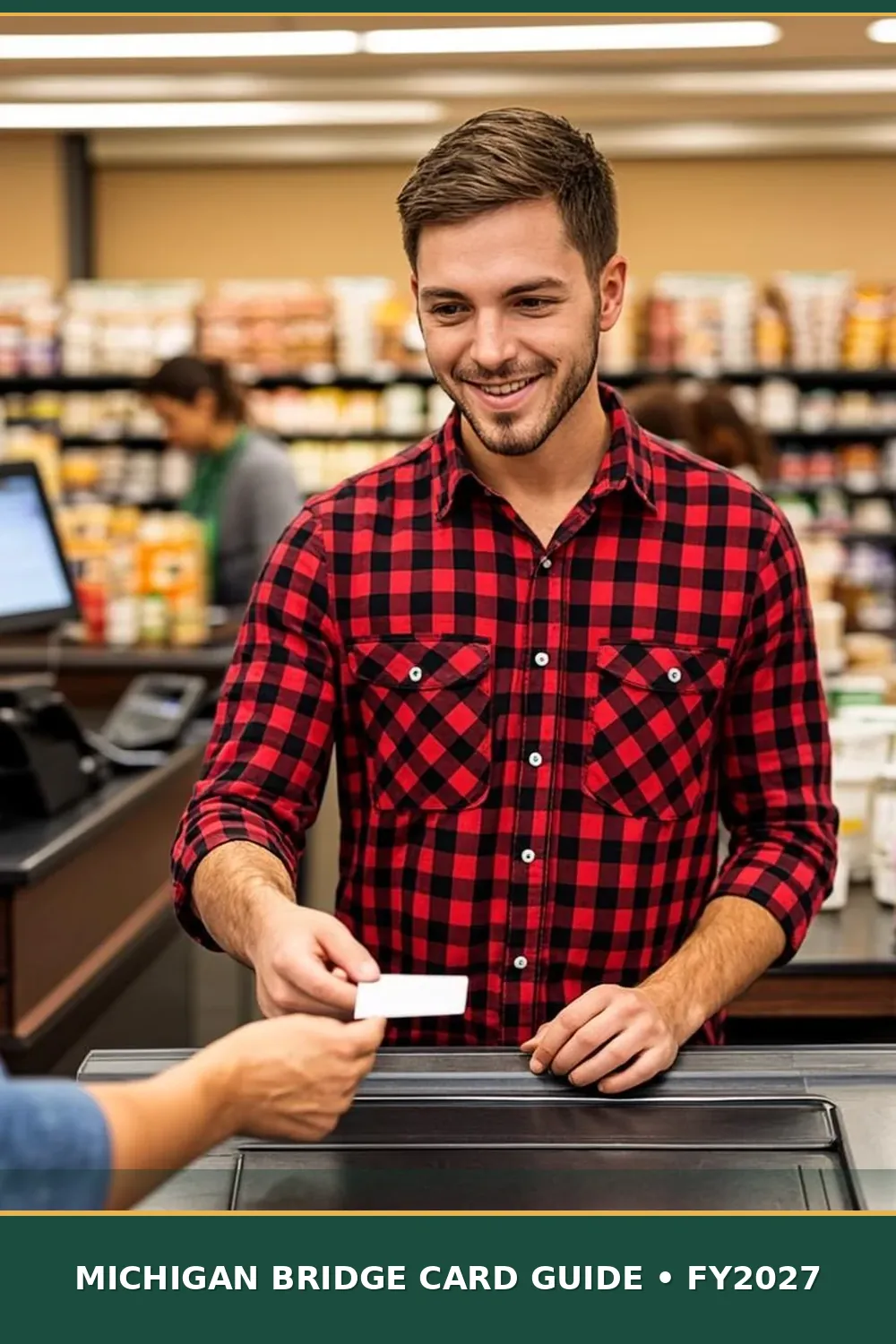
Michigan loads SNAP benefits onto a card called the Bridge Card. It behaves exactly like a PIN-protected debit card at checkout.
Monthly deposits post on the schedule MDHHS assigns when your case opens. Unused balances roll forward. The card works at grocers statewide plus participating farmers markets.
Damaged or lost cards are replaced through customer service at 1-888-678-8914. The line answers around the clock with Spanish and Arabic support.
A new PIN can be set the same day. Keep old cards only until the replacement arrives and works. Then destroy the plastic so nobody can attempt use.
Receipts display your remaining balance, the simplest way to track spending. The ebtEDGE website and app let you check funds without calling.
Look for the QUEST logo when traveling. The card works at EBT retailers in every state, which matters for Michigan snowbirds heading south.
The 274-Day Rule for Unused Benefits
Bridge Card benefits do not wait forever. Federal rules require Michigan to remove any food benefit left unused for nine months.
That works out to 274 days. The removal is permanent, and the balance does not return once expunged. A 2018 federal law shortened this window from a full year.
The protection is easy to use. Make one purchase with the card at least once every nine months, and the clock resets.
MDHHS also mails a warning 30 days before removal. Seniors who stockpile benefits should note the rule well. A hospital stay can silently eat the entire window.
Shopping Online from Michigan
Bridge Card holders can buy groceries online from a long list of retailers. Eligible food is paid for exactly as a debit card would be. Michigan's roster goes beyond the national names and includes several homegrown chains.
- Amazon and Walmart, the two national pickup-and-delivery leaders
- Kroger at every Michigan store, plus Aldi and Earth Fare
- Meijer, with 119 participating locations across the state
- Gordon Food Service, with 51 Michigan stores in the program
- Quality Dairy, with 26 participating stores
- Bridge Street Market in Grand Rapids, Capital City Market in Lansing, Rivertown Market in Detroit, and Woodward Corner Market in Royal Oak
- Country Life Natural Foods in Pullman and Freddie's Family Market in Atlanta, Michigan
Two cost details matter. Delivery fees cannot be paid with food benefits, so Walmart curbside pickup is a popular way to skip the fee.
Amazon waives delivery charges on grocery orders over $35. Cash assistance and WIC benefits on the same card cannot be used online, so keep those for in-person checkout.
Double Up Food Bucks Doubles Your Produce
Michigan runs one of the country's most successful produce-matching programs. Double Up Food Bucks adds a dollar-for-dollar match on fruits and vegetables.

It works every time a Bridge Card is used at a participating store or market. The Fair Food Network has led it since 2009. Families have brought home more than $70 million pounds of healthy food through it.
The current rules are generous. Participants can earn up to $50 a day in matching funds.
The match covers frozen produce as well as fresh, with no added salt, sugar, or fat. More than 240 locations participate statewide. They include major grocery chains and markets in both peninsulas.
Mechanics differ slightly by store. Some locations print matching coupons at the register.
Some load credit onto a store loyalty account, and some issue the purple Double Up card. Staff will explain the local version on your first trip. Flint residents get extra options through a city-specific expansion, so check the location finder.
No separate application exists, because eligibility rides on the Bridge Card itself. Swipe, buy produce, and the match accrues automatically. A family spending $40 of benefits on produce effectively brings home $80 of fruits and vegetables.
Restaurant Meals for Older and Disabled Residents
Michigan participates in the federal Restaurant Meal Program. It lets certain residents buy prepared meals with food benefits. Every member of the group must fit one of the descriptions below.
The list covers people 60 or older, people receiving disability or blindness payments, and people experiencing homelessness. The spouse of someone who qualifies counts too. No separate application is needed.
The program matters most for people who cannot safely cook. That includes residents of motels, shelters, and rooms without kitchens.
MDHHS maintains a searchable restaurant map on its site. Restaurants join voluntarily by signing an agreement with the state. The roster keeps growing across Detroit, Grand Rapids, Flint, and other cities.
Purchased meals follow normal food benefit rules for what counts. Questions about a specific restaurant go to the store or to MDHHS. Restaurant owners can reach the program team directly by email through the state site.
Summer EBT for Michigan Kids
Michigan Summer EBT, often called SUN Bucks, sends $120 per eligible school-age child. The money arrives when school lets out for summer.
It loads onto a card or onto the household's existing Bridge Card account. Children who receive other summer meal programs can still receive SUN Bucks, because the programs stack.
Some families are enrolled automatically through school meal records. Others must file a short application on the state Summer EBT page.
Families that move should update their address promptly, since cards mail from school records. Applying or receiving SUN Bucks has no effect on anyone's immigration status.
Work Rules After March 2026
Michigan's work landscape changed on March 1, 2026. A long-standing federal waiver expired at the end of February.
Time Limited Food Assistance rules are the state's version of the federal ABAWD time limit. They now apply across nearly the whole state. Adults from 18 through 64 must show work or qualifying activity to keep benefits.
The MDHHS work requirements page lists every detail. The hours target is 80 a month, which averages 20 hours a week.
Paychecks can meet the test when earnings average at least 20 weekly hours at the federal minimum wage. Community service, a Michigan Works! employment program, or workfare can substitute.
Michigan offers an unusual arithmetic shortcut for service hours. Work unpaid at a nonprofit when your hours equal the group's benefit divided by the state minimum wage.
The state minimum wage stands at $13.73 in 2026. Every hour then counts toward the requirement without a paycheck involved.
Three months in 36, and the early-start counties
Adults subject to the limit receive three countable months in a 36-month window. Those are months of benefits without meeting the requirement.
Good cause, a deferral, or a qualifying condition pauses the count. Michigan also honors deferral exceptions for Native American participants.
Two wrinkles catch people by surprise. Parents now count when their youngest child turns 14, because the federal age threshold dropped.
Three counties also began enforcing the rules a half year early. Kent County outside Grand Rapids, Oakland County outside Oak Park and Pontiac, and Livingston County started October 1, 2026.
The areas still waived
A short list of areas still holds waivers under the new federal criteria. Residents of the following counties and cities are not subject to the time limit right now.
| Waived areas from March 2026 | Coverage |
|---|---|
| Alcona, Alger, Arenac, Cheboygan, Iosco, Iron, Luce, Mackinac, Montmorency, Oceana, Ogemaw, Oscoda, Presque Isle, Roscommon, Schoolcraft | entire county, all cities included |
| Bay City, Detroit, Eastpointe, Flint, Jackson, Saginaw | the city limits only, not surrounding townships |
Report your hours through MI Bridges or at any local office. Keep pay stubs or a supervisor's letter handy as proof.
Exemptions run wider than the waived map. People who are medically unfit to work, pregnant, or caring for a child under 6 sit outside the limit entirely. Half-time students and people in treatment programs qualify as well.
Reporting Changes and Renewal Cycles
Most Michigan households keep benefits for 12 months before renewing. MDHHS mails a renewal packet before the period ends.
Some households with fast-changing income get shorter six-month certifications. Households where every member is 60-plus or disabled, with no earned income, can stretch to 24 months.
Mid-period changes matter as much as the renewal. Report new jobs, income jumps, people moving in or out, and address changes.
Use MI Bridges, the phone line, or a county office. Filing promptly prevents overpayment notices later, because benefits recalculated on stale facts create debts the state will pursue.
Stolen Cards and Scam Alerts
Card skimming hit Michigan hard in recent years. Scammers still run text campaigns that pretend to be MDHHS.
The state never asks for your PIN by text, email, or phone. No legitimate message needs your full card number. Cover the keypad at checkout and check the card slot for overlays.
Federal replacement money for stolen benefits had a deadline, and it has passed. Michigan could replace benefits stolen through cloning, skimming, or phishing only within a fixed window.
The window ran from October 1, 2022 to December 20, 2024. Prevention is the only protection left. Change your PIN at 1-888-678-8914 if anything feels off, and spend benefits promptly.
Non-Citizen Eligibility After April 2026
Federal law narrowed non-citizen eligibility effective April 2026. The change applies in Michigan like everywhere else.
Asylum seekers, refugees, and parolees who previously qualified through humanitarian categories no longer do. The qualifying list now centers on lawful permanent residents and Cuban and Haitian entrants. Citizens of Compact of Free Association nations qualify as well.
Green card holders generally face a five-year wait after obtaining status. Children, veterans, and several other groups skip the wait.
A household with mixed statuses can still apply for the eligible members. Applying for a child does not affect the adults' immigration cases.
Citizen children remain fully eligible even when parents are not. School meals, WIC, and summer EBT operate under separate rules that remain open wider than SNAP. Families weighing the risk can ask a caseworker to check a specific status against the current federal chart.
Students, Military Families, and Migrant Workers
College students follow special screening. Students enrolled at least half-time qualify only when another door opens.
A work-study award, caring for a young child, or a documented disability can open it. Michigan also extends eligibility to students in certain career and technical education programs. That state-specific expansion is listed on the MDHHS site.
Military families in Michigan apply through the same MI Bridges portal as everyone else. Basic Allowance for Housing counts as income.
Combat pay can be excluded in some situations, so list all pay types and let the caseworker sort them. Families using SNAP at on-base commissaries also benefit from prices that run below civilian grocers.
Michigan's migrant and seasonal farmworkers get dedicated support. MDHHS runs a Farmworker Outreach Services Division that publishes materials in Spanish.
Migrant workers may qualify under special household and residency interpretations. The case line at 1-844-464-3447 connects to interpreters for callers who need one.
If MDHHS Says No: Your Appeal Rights
A denial or a benefit cut always comes with a written notice that explains the reason. You have the right to a fair hearing before an administrative law judge.
The request must be filed within 90 days of the notice date. Asking is free. The form goes in through MI Bridges, by mail, or at any county office.
Timing changes the outcome. Request the hearing before the reduction takes effect and benefits continue at the old level until the judge decides.
Any overpaid amount may later be collected. Michigan Legal Help offers free step-by-step guides to the hearing process. Legal aid offices also represent income-qualified appellants at no cost.
Many appeals resolve before the hearing date. Caseworkers re-review the file when new documents arrive.
A corrected rent receipt or a missing pay stub often flips the decision without a judge. Send the documents, then keep the hearing request alive until the fix is confirmed in writing.
How Michigan Counts Overtime and Seasonal Wages
Auto plant schedules, warehouse peaks, construction seasons, and tourism swings make Michigan a state of variable paychecks. MDHHS counts what you actually receive and expects changes to be reported.
It also uses averaging for irregular earnings. If overtime is occasional, note that distinction during the interview. Caseworkers can assess income in the way that best reflects reality.
The FY2027 standards set the outer edges. Gross income faces Michigan's 200 percent door, and net income faces the 100 percent chart.
Maximum allotments run $306 for one person to $1,841 for eight. Deductions for dependent care matter for shift workers whose childcare keeps the job possible. Those receipts reduce countable income dollar for dollar.
Seasonal layoffs deserve special handling. A construction worker between December and March can document that the layoff is temporary.
An auto worker on a temporary plant shutdown falls in the same category. When the return date is known, income from the suspended job is counted differently than a permanent job loss. Bring the layoff letter or union notice to the interview.
Self-employed contractors report income after business expenses. Mileage, tools, and platform fees all subtract before counting.
Keep a simple monthly log rather than reconstructing a year at renewal time. A clean log prevents both underestimates that trigger overpayments and overestimates that shrink the benefit.
County Offices and Community Navigators
Even with a strong portal, MDHHS maintains local offices across all 83 counties. Some tasks, identity verification for example, resolve faster face to face.
If your case stalls, call the office listed on your notices. Ask for a supervisor of the day rather than waiting for a callback. The Food Bank Council of Michigan and its regional members coordinate pantries while applications are pending.
Pathways to Potential, MDHHS's school-based support program, places caseworkers in dozens of school buildings. Parents can get benefit questions handled during pickup hours. Ask at your district office whether a Pathways worker is assigned to your school.
United Way's 211 line is another fast route to help. It connects callers to pantries, application assistance, and utility programs in their own county.
Libraries in Detroit, Grand Rapids, Lansing, and most county seats stock paper applications. Nobody in Michigan should have to navigate the paperwork completely alone.
More Help on the Same Application
The MI Bridges application screens you for several programs at once. The Family Independence Program provides cash assistance to families with children.
State Emergency Relief covers crisis costs such as utility shutoffs and eviction. Medicaid screening runs in the same flow. WIC serves pregnant women and young children with its own, more generous income limits.
Utility help connects to food benefits through the deduction rules as well. Heating assistance increases the shelter deduction, which raises the SNAP benefit.
Our guide to pairing LIHEAP and SNAP explains the interaction. Michigan's Weatherization and water assistance programs appear in the same portal, so one application can open several doors.
Answer every program question in the application even if you doubt you qualify. The screening costs nothing extra.
Families are routinely surprised by one more program that fits. Declining a program later is always easier than missing it entirely.
Frequently Asked Questions
How much food stamps will I get in Michigan?
Your benefit equals the maximum for your household size minus 30 percent of net income. A family of three with $150 net income receives $763.
A single person with $500 net receives $156. One- and two-person groups never fall below $25.
What income qualifies for SNAP in Michigan?
Most Michigan households can apply with gross income up to 200 percent of poverty. That is about $2,660 monthly for one person.
Net income after deductions must still fall under the 100 percent chart. Households with a 60-plus or disabled member skip the gross test entirely.
What day does my Bridge Card refill?
Deposits land between the 3rd and the 21st of each month. The day is chosen by the last digit of your client number.
A number ending in 0 refills on the 3rd. A number ending in 9 refills on the 21st. Holidays never shift the date.
Can I have savings and still get food assistance?
Yes for most households, because Michigan dropped the asset test in March 2024. Bank balances, cars, and retirement funds do not count for ordinary groups. Only groups with a disqualification for program violations face the $3,000 or $4,750 limits.
How do I apply for food stamps in Michigan?
Apply online through MI Bridges, or file a paper application at any county MDHHS office. After you submit, an interview is scheduled and MDHHS decides within 30 days. Households with nearly no income qualify for a seven-day expedited decision.
Do Michigan work requirements apply to everyone now?
From March 2026, adults 18 through 64 must average 80 work hours monthly beyond three countable months in 36. Fifteen counties and six cities, including Detroit and Flint, remain waived. Seniors, medically unfit adults, and several other groups are exempt.
Can I use my Bridge Card online or in another state?
Both work. Amazon, Walmart, Kroger, Meijer, Aldi, and several Michigan independents accept the card online.
Delivery fees need another payment method. The QUEST logo means your card works at EBT retailers in every state.
Who can buy restaurant meals with food benefits?
Groups where every member is 60 or older, disabled, homeless, or a qualifying spouse can use benefits at participating restaurants. No application is needed. MDHHS publishes a map of enrolled locations across the state.
Compare Michigan with Its Neighbors
Michigan's 200 percent door and no-asset-test policy stand out in the Great Lakes region. Wisconsin runs a standard federal screen under its FoodShare brand.
Ohio adds extra deductions for vehicle costs. Indiana keeps a 130 percent door with a resource test for some groups. Our Wisconsin guide details those differences.
If you live in the Thumb or the U.P., crossing a border for groceries may be routine. Your Bridge Card works anywhere in the country.
Estimate your benefit with the calculator above. Compare with the Ohio guide or Indiana guide, and use the all-states directory to jump to any other page.